In short
- 15 of the 27 EU countries protect at least one mushroom species (non-lichenised fungi) in national law.
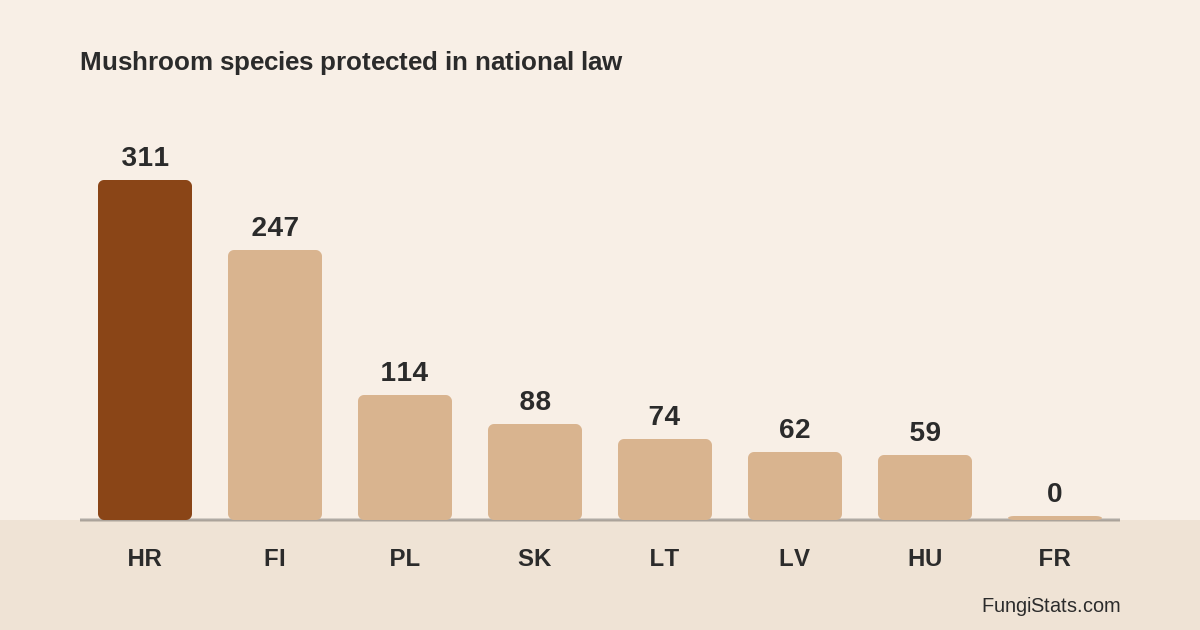
- Croatia protects the most, 311, then Finland (247), Poland (114), Slovakia (88) and Lithuania (74). Malta protects 3 and Sweden 5.
- Twelve protect none nationally: Austria, Belgium, Cyprus, Denmark, France, Greece, Ireland, Italy, the Netherlands, Portugal, Romania and Spain. In Austria, France, Italy and Spain, protection is set by regions instead.
- Counting lichens, which are also fungi, Finland protects the most species overall: 247 mushrooms and 472 lichens.
Why it matters
EU nature law does almost nothing for fungi. The only fungi protected at EU level are a group of reindeer lichens, under the Habitats Directive; no mushroom is listed. So whether a threatened mushroom has any legal protection depends on the country, and the same species can be protected on one side of a border and not on the other. The audit also notes that most protected species are protected in only one country.
Every EU country
| Country | Mushroom species protected | Lichens protected | Note | Rank |
|---|---|---|---|---|
| Croatia | 311 | 35 | 1 | |
| Finland | 247 | 472 | 2 | |
| Poland | 114 | 199 | 3 | |
| Slovakia | 88 | 44 | 4 | |
| Lithuania | 74 | 44 | 5 | |
| Latvia | 62 | 60 | 6 | |
| Hungary | 59 | 18 | 7 | |
| Luxembourg | 55 | 117 | 8 | |
| Estonia | 46 | 51 | 9 | |
| Czechia | 46 | 0 | 10 | |
| Slovenia | 41 | 1 | 11 | |
| Germany | 18 | 8 | 12 | |
| Bulgaria | 10 | 0 | 13 | |
| Sweden | 5 | 8 | 14 | |
| Malta | 3 | 2 | 15 | |
| Cyprus | 0 | 1 | ||
| Ireland | 0 | 1 | ||
| Romania | 0 | 1 | ||
| Austria | 0 | 0 | regional lists only (no national list) | |
| Belgium | 0 | 0 | no fungi or lichens in national protection law | |
| Denmark | 0 | 0 | no fungi or lichens in national protection law | |
| France | 0 | 0 | regional lists only (no national list) | |
| Greece | 0 | 0 | no fungi or lichens in national protection law | |
| Italy | 0 | 0 | regional lists only (no national list) | |
| Netherlands | 0 | 0 | no fungi or lichens in national protection law | |
| Portugal | 0 | 0 | no fungi or lichens in national protection law | |
| Spain | 0 | 0 | regional lists only (no national list) |
Related data
Method and caveats
- Source. Daniel Janowski, "The legally protected fungi and lichens in the EU", IMA Fungus 17: e202399 (August 2026), Table 1. We summed the counts for each country across the national instruments that protect species.
- Excluded: rules that only regulate picking or sale (for example, Croatia's ordinance on collecting wild species), which the audit lists separately.
- "Mushroom species" means non-lichenised fungal taxa as counted in the audit; lichens are shown separately.
- Regional protection (in Austria, France, Italy and Spain) is not counted, because it varies by region.
- Countries are listed from most to fewest protected species. Countries with none are listed alphabetically after Malta.
- This page is about law and conservation. It gives no identification, foraging or health advice.
Sources
- Janowski D (2026). The legally protected fungi and lichens in the EU. IMA Fungus 17: e202399. Published 24 August 2026. https://doi.org/10.3897/imafungus.17.202399 (accessed 20 November 2026)
- Janowski D (2026), Table 1 data (CSV). https://imafungus.pensoft.net/article/202399/download/csv/21/ (downloaded 20 November 2026)
- Council Directive 92/43/EEC (Habitats Directive), Annexes II, IV and V. https://eur-lex.europa.eu/eli/dir/1992/43/oj (accessed 21 November 2026)
This is a data piece about conservation law. It contains no product links or advertising and gives no identification, foraging or health advice. Corrections: brian@fungistats.com.
The data is free to reuse under CC BY 4.0 with credit to FungiStats and a link to this page. Download the CSV.