In short
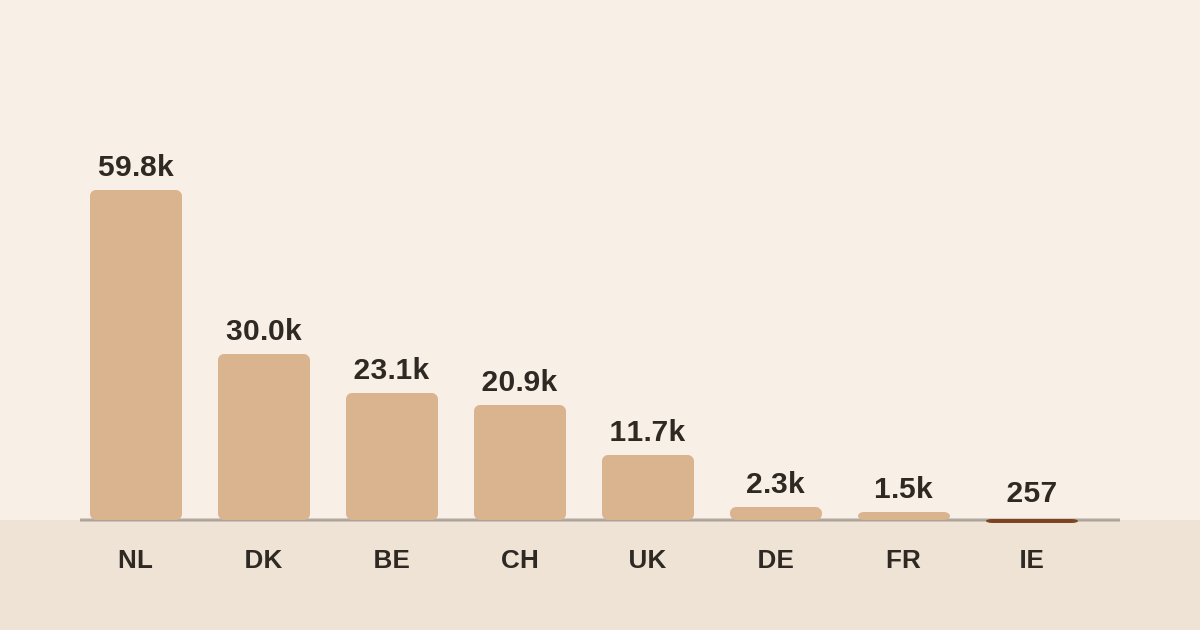
- Ireland has 17,709 publicly shared records of mushrooms and bracket fungi in GBIF, the global open biodiversity database. That's 257 per 1,000 km² of land (our calculation).
- That puts Ireland 24th of 25 European countries we compared. Only Croatia (192) has fewer per km². The UK has 11,692, about 45 times Ireland's rate. The Netherlands has 59,811.
- Counting every kind of fungus, lichens included, Ireland has 103,997 records, or 1,510 per 1,000 km². That's 21st of 25.
- Recording is picking up. Ireland logged 1,031 mushroom records in 2025, the most in any year since 2010.
- The death cap (Amanita phalloides) has 49 records in Ireland, ever.
Why records matter
Ireland protects no mushroom species in law and has never published a Red List for fungi (see our count). A Red List assessment needs records: where a species has been found, and whether it's still turning up. Where few people record fungi, there is little to assess.
GBIF pulls together records shared by recording schemes, museums, herbaria and citizen-science apps. For Ireland, the largest sources of mushroom records are the Fungal Records Database of Britain and Ireland (7,034), the National Biodiversity Data Centre's general records (4,117) and iNaturalist (3,741).
Country by country
| Country | Mushroom records (all years) | Per 1,000 km² | All fungi and lichens per 1,000 km² |
|---|---|---|---|
| Netherlands | 2,013,834 | 59,811 | 106,195 |
| Denmark | 1,200,807 | 30,020 | 43,252 |
| Belgium | 704,632 | 23,107 | 30,932 |
| Switzerland | 825,794 | 20,901 | 33,488 |
| Estonia | 838,600 | 19,626 | 42,726 |
| United Kingdom | 2,828,765 | 11,692 | 38,984 |
| Luxembourg | 28,249 | 10,973 | 21,443 |
| Sweden | 3,588,518 | 8,811 | 17,284 |
| Slovenia | 163,796 | 8,134 | 9,570 |
| Austria | 670,938 | 8,131 | 13,265 |
| Norway | 1,167,933 | 3,206 | 6,661 |
| Finland | 727,674 | 2,394 | 4,454 |
| Germany | 812,486 | 2,326 | 5,644 |
| France | 783,891 | 1,454 | 2,329 |
| Lithuania | 88,984 | 1,421 | 3,003 |
| Latvia | 87,363 | 1,404 | 2,710 |
| Czechia | 99,288 | 1,287 | 4,658 |
| Spain | 491,668 | 984 | 2,349 |
| Italy | 219,602 | 743 | 2,019 |
| Portugal | 53,020 | 579 | 2,380 |
| Slovakia | 22,996 | 478 | 1,485 |
| Poland | 128,708 | 420 | 1,509 |
| Hungary | 26,005 | 285 | 702 |
| Ireland | 17,709 | 257 | 1,510 |
| Croatia | 10,767 | 192 | 514 |
Ireland, year by year
Irish records peaked between 2008 and 2010, at around 1,000 a year, then fell to between 200 and 450 a year for most of the 2010s. They have risen again since 2020: 775 in 2020, 837 in 2024, 1,031 in 2025 and 899 so far in 2026.
Poisonous species
Some species known to be deadly poisonous have very few Irish records:
- Death cap (Amanita phalloides): 49 records, 6 of them in 2026
- Funeral bell (Galerina marginata): 27
- Destroying angel (Amanita virosa): 6
- Deadly webcap (Cortinarius rubellus): 6
Few records don't mean a species is rare, only that few finds have been logged and shared. Ireland's poison information centre gets about 50 calls a year about mushrooms, according to figures reported in August 2026.
Related data
Method and caveats
- Records, not fungi. These counts measure how much recording has been done and shared, not how many fungi grow in a country.
- Shared to GBIF only. Some national schemes hold records they haven't shared with GBIF, and some records are duplicated across datasets.
- Mushroom records are GBIF occurrences in class Agaricomycetes, which covers gilled mushrooms, boletes, brackets and puffballs. "All fungi" is kingdom Fungi, which in GBIF includes lichens.
- United Kingdom includes Northern Ireland. GBIF records the whole UK under one country code.
- Area is World Bank land area (2022), and population is World Bank 2024. Rates per 1,000 km² and per 100,000 people (in the CSV) are our calculation.
- We queried GBIF on 21 November 2026. Counts change as new records are shared.
- This page is about recording and data. It gives no identification, foraging or health advice.
Sources
- GBIF.org, occurrence search API, country and taxon counts, queried 21 November 2026. https://www.gbif.org/occurrence/search?country=IE&taxon_key=186
- GBIF datasets: Fungal Records Database of Britain and Ireland; General Biodiversity Records from Ireland (National Biodiversity Data Centre); iNaturalist Research-grade Observations. https://www.gbif.org/ (accessed 21 November 2026)
- World Bank, Land area (sq. km), AG.LND.TOTL.K2, 2022, and Population, total, SP.POP.TOTL, 2024. https://data.worldbank.org/indicator/AG.LND.TOTL.K2 (accessed 21 November 2026)
- Olivia Kelleher, Echo / breakingnews.ie, 28 August 2026, on the National Poisons Information Centre's 2025 figures (about 50 mushroom calls a year). https://www.echolive.ie/nationalnews/arid-41903491.html (accessed 21 November 2026)
- FungiStats, "Ireland protects 0 mushroom species by law", 20 November 2026 (first published on fungi.ie). /ie/data/protected-mushroom-species-ireland-eu/
The data is free to reuse under CC BY 4.0 with credit to FungiStats and a link to this page. Download the CSV.