In short
- 268 interventional trials on ClinicalTrials.gov give psilocybin and list at least one site. They have run in 23 countries.
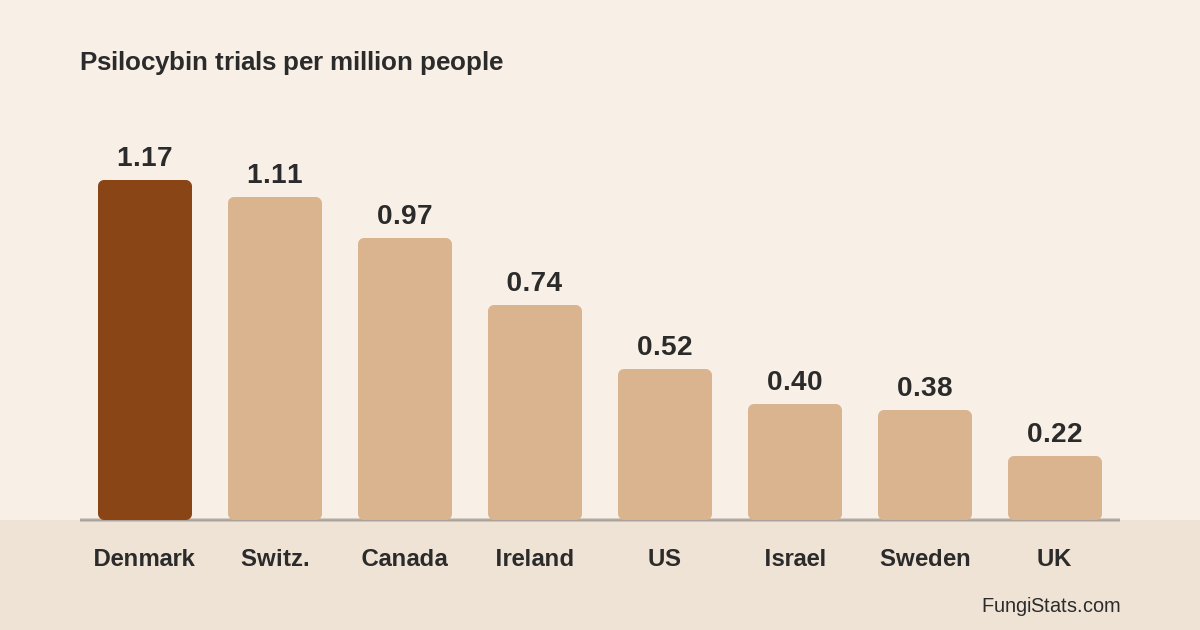
- Per head, Denmark leads with 7 trials, 1.17 per million people, followed by Switzerland (10 trials, 1.11), Canada (40, 0.97) and Ireland (4, 0.74).
- The United States has the most trials by far, 176, and 105 of them are active or recruiting. Per head that is 0.52 per million, 5th.
- Germany (3 trials) and France (7) have hosted few relative to their size: 0.04 and 0.10 per million.
What this measures
This is a count of research activity: where psilocybin trials have taken place. It says nothing about whether psilocybin works or is safe for any condition, and psilocybin remains a controlled drug in almost every country listed.
A trial counts for a country if it lists at least one site there, so large multi-country trials count in each country they ran in. ClinicalTrials.gov is the largest trial registry but not the only one, so some trials registered only in national or regional registries are missing.
Every country
| Country | Trials with a site | Active or recruiting | Per million people | Rank |
|---|---|---|---|---|
| Denmark | 7 | 3 | 1.17 | 1 |
| Switzerland | 10 | 3 | 1.11 | 2 |
| Canada | 40 | 28 | 0.97 | 3 |
| Ireland | 4 | 1 | 0.74 | 4 |
| United States | 176 | 105 | 0.52 | 5 |
| Israel | 4 | 4 | 0.40 | 6 |
| Sweden | 4 | 3 | 0.38 | 7 |
| Czechia | 4 | 2 | 0.37 | 8 |
| Netherlands | 5 | 4 | 0.28 | 9 |
| United Kingdom | 15 | 3 | 0.22 | 10 |
| New Zealand | 1 | 0 | 0.19 | 11 |
| Portugal | 2 | 1 | 0.19 | 12 |
| Finland | 1 | 0 | 0.18 | 13 |
| Belgium | 2 | 1 | 0.17 | 14 |
| Australia | 3 | 1 | 0.11 | 15 |
| Austria | 1 | 1 | 0.11 | 16 |
| France | 7 | 4 | 0.10 | 17 |
| Spain | 2 | 1 | 0.04 | 18 |
| Germany | 3 | 1 | 0.04 | 19 |
| Poland | 1 | 1 | 0.03 | 20 |
| Argentina | 1 | 0 | 0.02 | 21 |
| Brazil | 2 | 2 | 0.01 | 22 |
| Pakistan | 2 | 1 | 0.01 | 23 |
Related data
Method and caveats
- Search. ClinicalTrials.gov API (v2), interventional studies with "psilocybin" as an intervention, queried 21 November 2026: 300 studies.
- Kept: 283 trials in which an intervention is named psilocybin (or COMP360, a psilocybin formulation). Dropped: trials of related compounds such as psilocin analogues, and follow-up studies in which no psilocybin is given. 268 of the 283 list a site.
- Countries come from each trial's listed sites. Every trial ID is in the CSV.
- Rate = trials with a site ÷ World Bank population 2024 × 1,000,000 (our calculation).
- This page reports research activity and is not medical advice.
Sources
- ClinicalTrials.gov (US National Library of Medicine), API v2, interventional studies, queried 21 November 2026. https://clinicaltrials.gov/
- World Bank, Population, total (SP.POP.TOTL), 2024. https://data.worldbank.org/indicator/SP.POP.TOTL (accessed 21 November 2026)
This is a data piece about where research takes place. It contains no product links or advertising and gives no health advice. Corrections: brian@fungistats.com.
The data is free to reuse under CC BY 4.0 with credit to FungiStats and a link to this page. Download the CSV.